On this page
What are the classes of fire in India?
The Indian Standard for extinguishers, IS 2190:2024, lists five classes of fire: A, B, C, D and F. Each class is named for what is burning, because that decides which extinguisher will put it out.
- Class A: solid materials such as wood, paper, rubber and plastics.
- Class B: flammable liquids such as petrol, diesel and kerosene.
- Class C: flammable gases, including LPG.
- Class D: combustible metals such as magnesium, aluminium and sodium.
- Class F: cooking oils and fats in cooking appliances. The standard notes it may be called a kitchen fire.
The letters differ from those on many websites. In US usage, C means electrical fires and K means cooking oil, so a chart copied from a US page can send you to the wrong extinguisher in India.
Every fire needs heat, fuel and oxygen, which is the fire triangle. An extinguisher works by taking away one of the three, and each type does it differently.
What class of fire is an electrical fire?
An electrical fire has no class letter in the Indian list: IS 2190:2024 treats it as a Class A or B hazard with live equipment involved. So the extinguisher must also be marked as suitable for live electrical equipment, and the power should be switched off as soon as it's safe to do so.
What are the types of fire extinguishers and their uses?
The Bureau of Indian Standards lists six extinguishing media: water, foam, dry chemical powder, carbon dioxide, clean agents and water mist. Wet chemical extinguishers, made for kitchens, are also sold here, and the type is marked on the body of each extinguisher.
Don't go by colour. Read the label on the body, because the type is marked there.
Which fire extinguisher do you use on which fire?
An ABC powder extinguisher covers classes A, B and C and electrical fires, which is why it suits most rooms. For anything else, match the extinguisher to what is burning, using this chart.
| What is burning | Water | Foam | ABC powder | CO₂ | Wet chemical |
|---|---|---|---|---|---|
| A: wood, paper, cloth, plastics | Yes | Yes | Yes | No | Yes |
| B: petrol, diesel, paint | No | Yes | Yes | Yes | No |
| C: LPG and other gases | No | No | Yes | No | No |
| D: metals | No | No | No | No | No |
| Electrical | No | No | Yes | Yes | No |
| F: cooking oil and fat | No | No | No | No | Yes |
A metal fire needs a special Class D powder; the Indian powder standard, IS 4308, has a separate D type.
On a gas fire, stop the gas first. IS 2190:2024 says extinguishers using anything other than powder are relatively ineffective on pressurised gas fires, and that it's undesirable to put out such a fire at all unless the fuel can be shut off promptly.
Which fire extinguisher is used for electrical fires?
Use CO₂ or powder on live electrical equipment, in an extinguisher marked as suitable, and never water. IS 2190:2024 also allows water mist types tested for it, but says CO₂ extinguishers with metal horns aren't safe on live equipment.
For panels and server rooms, CO₂ has an advantage: the standard warns that powder residue can seriously damage delicate electronics. Don't use CO₂ in a confined space with people in it unless they have breathing protection.
What is a class F (or K) fire, and what puts it out?
A class F fire is burning cooking oil or fat. India uses the letter F and the US uses K for the same fire, and it needs an extinguisher marked for Class F, usually a wet chemical type that sprays a fine mist.
Never use water or CO₂ on a deep fryer: an explosive reaction may result. This is the extinguisher to check for in a hotel, hospital or canteen kitchen, and IS 2190:2024 puts it within 10 m of travel.
Are ABC and DCP the same?
Not quite: DCP means dry chemical powder, which is the general category, and ABC is one type of it. BC powder (sodium or potassium bicarbonate) works on flammable liquids and gases, while ABC powder (monoammonium phosphate) also works on ordinary solids.
The Indian Standard for these powders, IS 4308, sets out BC, ABC and D types separately. If the label only says "DCP", check which type it is, because a BC extinguisher isn't meant for wood or paper.
Which is better, ABC or CO₂?
Neither is better everywhere: ABC powder suits most rooms, and CO₂ suits electrical equipment. CO₂ is not recommended for class A fires, because they can smoulder and re-ignite once the gas has gone.
ABC powder coats the fuel with a thin layer and leaves powder to clean up. So a building usually needs both, placed according to what is in each room.
Clean up powder promptly after any use: IS 4308 warns that with moisture it can corrode metals, and in humid conditions deposits on delicate equipment can become corrosive and conductive.
How do you use a fire extinguisher?
Remember PASS: Pull, Aim, Squeeze, Sweep. Stand within the extinguisher's effective range (it's on the label), with your way out behind you.
- Pull the pin.
- Aim low, at the base of the fire, not at the flames.
- Squeeze the lever to release the agent.
- Sweep from side to side across the base of the fire.
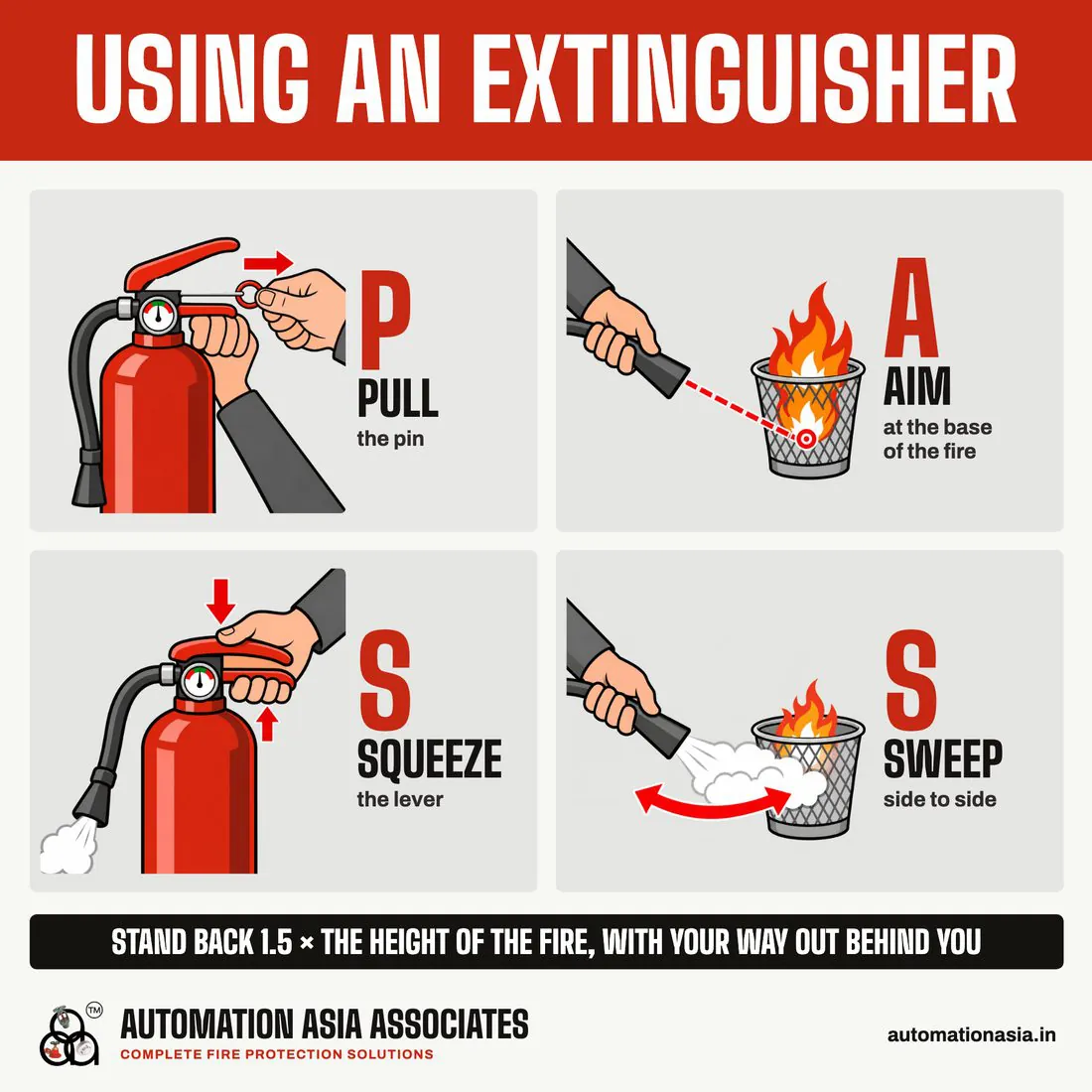
At our fire safety classes we teach people to stand back about 1.5 times the height of the fire. Then back away once the fire is out, in case it flares up again.
When should you not fight a fire?
Leave at once if the fire is spreading beyond where it started, if the extinguisher runs out, or if you have any doubt. Never let the fire, heat or smoke come between you and your way out.
Raise the alarm and call the fire service on 101. An extinguisher is for a small fire, and nothing in a building is worth your life.
What goes wrong with fire extinguishers?
What we see go wrong falls into two groups: an extinguisher that hasn't been looked after, and one that's used the wrong way. Regular checks catch the first, and a little training prevents the second.
The extinguisher itself:
- Lost pressure: the gauge needle has left the green.
- A clogged or blocked nozzle.
- Corrosion and rust: damp places speed it up, on the outer body and the internal springs. A heavily corroded extinguisher is discarded.
- Worn parts.
- Overdue: the extinguisher has gone past its service date, test date or 10-year life.
How it's used:
- The wrong type: water on an electrical or grease fire can cause electrocution or spread the flames.
- Poor technique: aiming at the top of the flames instead of the base, or fighting the fire against the wind, makes the agent ineffective.
- Small, closed spaces: CO₂ can displace the oxygen, and dry powder can severely cut visibility.
Where should fire extinguishers be installed?
Put them where people will pass on the way out, in plain view and not locked away. IS 2190:2024 asks for at least two on each floor (one if the floor is under 100 m²), with the top of a portable extinguisher no more than 1.5 m above the floor.
The furthest anyone should walk to reach one depends on the hazard: 20 m for solids in low and moderate hazard areas, 15 m in high hazard areas and for flammable liquids and gases, and 10 m for cooking oil. Keep the operating instructions facing out.
- No more than 20 m
- Within 10 m of the cooking
- Exit
How do you check a fire extinguisher's pressure gauge?
Look at the needle: in the green, the extinguisher is ready. In the red on the left, the pressure is low and it needs refilling; in the red on the right, it is overcharged and needs servicing.
CO₂ extinguishers have no gauge, so they are checked by weight during servicing. A gauge shows pressure only, so it doesn't replace the regular service below.
How often should a fire extinguisher be serviced, and does it expire?
Under IS 2190:2024, check an extinguisher about every three months and have a competent person maintain it once a year, and recharge it after any use. Yes, it expires: the standard gives a life of 10 years from the date of manufacture, or 15 years for CO₂.
It also needs a hydrostatic pressure test on a fixed schedule:
- Water and foam: every 3 years.
- Dry powder, CO₂ and clean agent: every 5 years.
An extinguisher that fails the test is discarded and replaced, whatever its age. Non-rechargeable extinguishers are discarded within 5 years of manufacture. Each extinguisher should carry a label showing when it was last serviced and tested, and that's the first thing to look at.
We supply and refill fire extinguishers, and our annual maintenance contract keeps them, and the rest of a building's fire protection systems, ready for the inspection when the fire NOC is renewed before it expires.
From automationasia.in/articles/fire-extinguishers · Last checked 8 November 2026